Category: Other

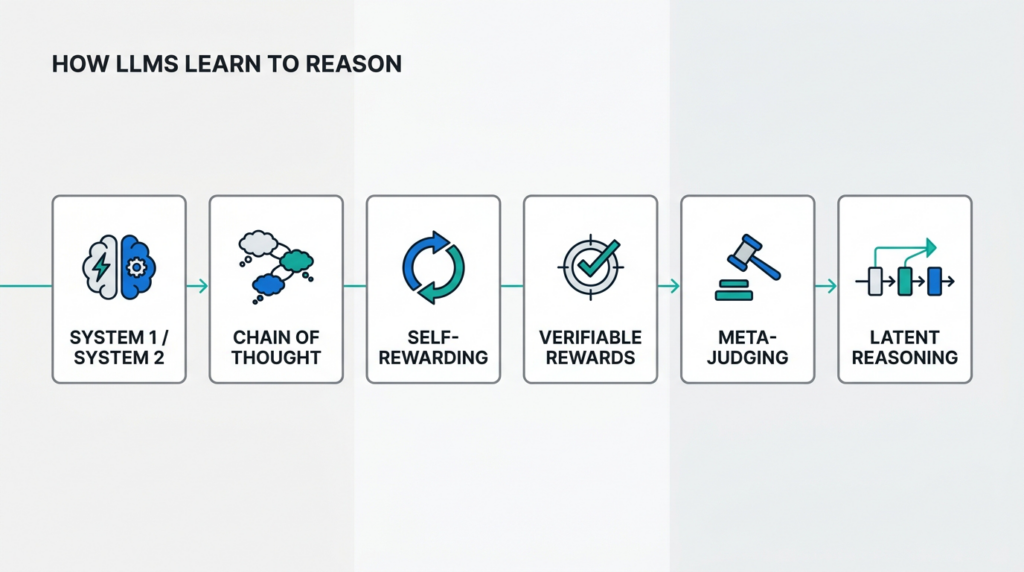
LLM_log #021: How LLMs Learn to Reason — From Chain-of-Thought to Self-Rewarding and Meta-Judges

Highlights: Jason Weston traces the arc from early neural language models to self-improving LLMs that generate their own training data and evaluate their own reasoning System 1 vs System 2: fixed-compute pattern-matching vs deliberate multi-step reasoning — and why the same LLM implements both Chain-of-Thought prompting: adding “Let’s think step by step” jumps GSM8K accuracy from ~10% to 40–50%; few-shot CoT hits 90%+ on MultiArith CoVe + S2A: Chain-of-Verification reduces hallucinations 3× on knowledge list…
Read more

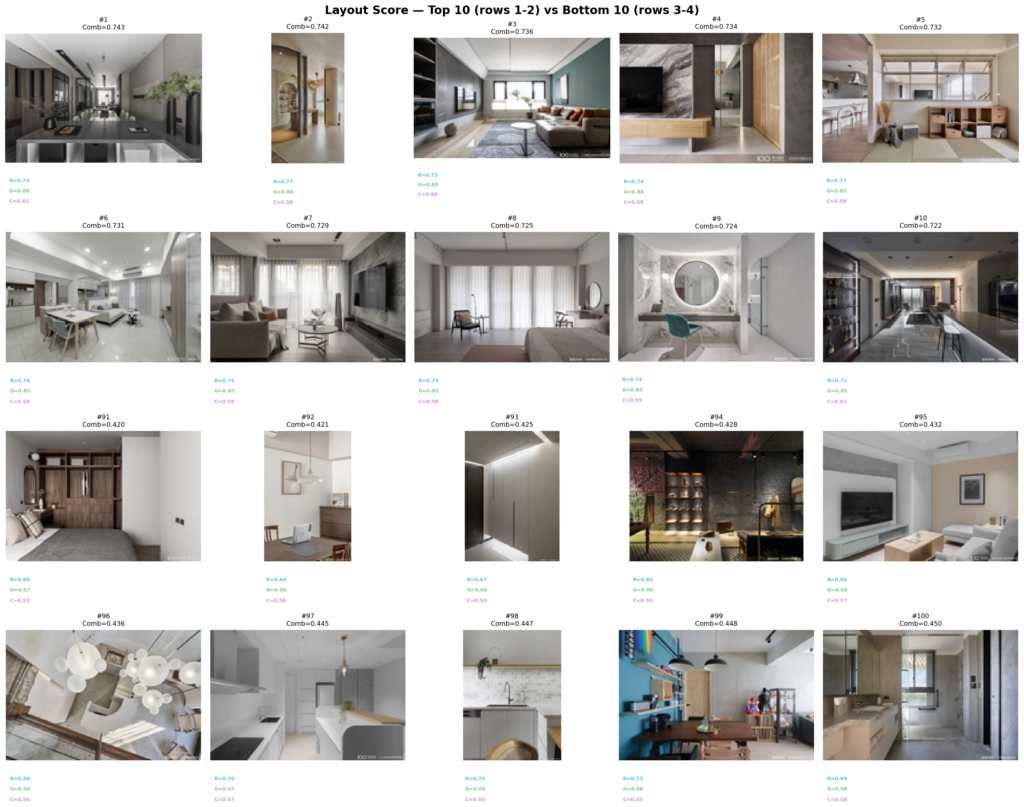
LLM_log #019: Layout Scoring — Does Furniture Placement Follow the Rule of Thirds?

Highlights: Can we measure spatial composition in living room photographs? We score 100 interior images using saliency-based rule-of-thirds alignment, Gemini Vision layout ratings, and CLIP composition prompts — then cross-correlate with color scores from #018 to find rooms that nail both color and layout. Method 1 — Rule of Thirds + Balance: gradient saliency → Gaussian-weighted power point alignment + visual balance index Method 2 — Gemini Vision Layout: send each image to Gemini 2.5…
Read more

LLM_log #018: Color Harmony Ranking — Three Methods, 500 Living Rooms

Highlights: Can three completely independent methods agree on which living room has the best colors? We rank 500 interior images using Cohen-Or harmonic templates, Hasler-Süsstrunk colorfulness, and CLIP IQA with 44 color-focused prompts — then measure whether they correlate at all. Method 1 — Cohen-Or: K-means palette → saturation-weighted hue histogram → sweep 7 harmonic templates × 36 rotations → H/T/S composite Method 2 — Hasler-Süsstrunk: opponent channels (rg, yb) → colorfulness + 4×4 spatial…
Read more

LLM_log #017: Scoring Color Harmony — From Two Squares to a Room

Highlights: Can you score color quality algorithmically? Not as taste — as math. This post builds a scoring system from first principles: two adjacent color squares, then triplets, then a real room with three spatial regions. We walk through every formula with brand and flag examples you already know, then prove that geometry alone can move the score by five points on an identical palette. Four pair scoring dimensions: contrast (WCAG luminance), harmony (hue peaks),…
Read more

LLM_log #016: RGB is for Screens. Lab is for Humans — Color Scoring for Living Room Images

Highlights: Every computer vision pipeline that touches color starts with the same mistake: using RGB. RGB is built for screens, not for human perception. In this post we build a complete color scoring system for living room images — from the right color space (Lab), through palette extraction (K-means), to a two-color harmony scorer tested on 10 global brand palettes. We discover why luxury brands deliberately score low, and what that means for your model.…
Read more